
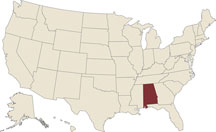
ALABAMA
From Site Selection magazine, May 2009

Green Machines
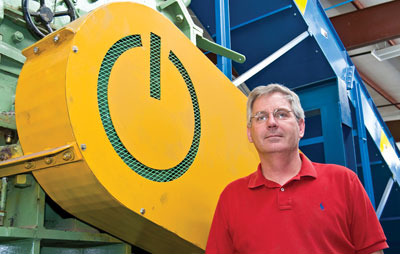
Jim Cunningham, managing partner of Ecovery LLC
I
f you own or use a cell phone, computer, printer, microwave, camera or any other electronic device, chances are it's not your first one. Imagine all the former models of these devices that are no longer in use – by you and by everyone else. That's a lot of equipment either in storage or in a landfill, where lead, mercury and other hazardous substances accumulate.
That's where Ecovery LLC comes in. Taking a cue from efforts in Europe to recycle electronic materials, such as aluminum, gold and silver, platinum, palladium and plastics, the company has found a niche for a product that is both in demand and in vogue. Ecovery chose a 30-acre (12-hectare) site in 2008 in Loxley, Ala., east of Mobile in Baldwin County, where it built a 35,000-sq.-ft. (3,250-sq.-m.) facility that will eventually employ 40 to 50 people. The company imports recycling machinery from four manufacturers in Europe, finishes it off with electrical systems and final controls and resells the equipment to companies involved in electronic waste processing.
"Europe is probably seven to 10 years ahead of the United States in their recycling efforts across all areas," says Jim Cunningham, managing partner of the LLC. "We're still wrestling in the U.S. with government regulations, whereas the Europeans have no problem administering very harsh regulations and requiring the population to comply very quickly. Electronic waste has a lot of valuable material in it." In 2008 alone, he points out, more than 70 percent of toxic "e-waste" went into landfills.
A Known Quantity
Baldwin County didn't have much competition when it came time to choose a location, according to Cunningham.
"My business partner had started some successful greenfield businesses here in the past, so it was at the top of our list of places to look at," he notes. Locations elsewhere in Alabama and some sites in Mississippi were given some consideration, but the Mobile area's proximity to several Gulf Coast ports and suppliers and Baldwin County's ease of doing business won the day.
"I've worked all over the U.S., and I find it very easy to work with the county government in terms of zoning changes and other work that needed to be done to place the facility where we did," says Cunningham. "We made a conditional offer on 30 acres [12 hectares] of agricultural land in mid-July. The recommendation to change the zoning to light industrial came in mid-August, and it was approved by the county board in mid-September."
Land disturbance permits were in hand by the first of October, and final construction permits were secured by October 7th. The company is using just 10 acres (4 hectares) at present but anticipates adding other businesses to the property within a couple of years.
"We moved pretty quickly," says Cunningham, in part because Baldwin County locations were eligible for Gulf Opportunity Zone incentives. "We were able to take bonus depreciation on anything we put into service by the end of the year, and we had our occupancy permits on or about December 29th. It was a fast-track project and a joy working with the county."
Machinery generally arrives for final assembly in Loxley via containerized cargo through the Ports of New Orleans, Savannah, Ga., or Jacksonville, Fla.; Mobile, Alabama's port handles mainly bulk products. Finished product is moved via truck to locations in North America or to ports for destinations overseas.
The company was hiring about three people per week as of mid-April, and finding workers with electrical and mechanical skills in a largely agricultural area has not been a problem. "Weighing the availability of labor, the skill level and value of the labor, this was by far much better than other areas we considered," says Cunningham. "The people in this area live on farms, so there's more mechanical aptitude than elsewhere."
But the strategic advantage of the Baldwin County location to Ecovery is broader. While ease of doing business and availability of semi-skilled labor were secondary factors, "We focused on Alabama and Mississippi because of where our customers and competitors were," says Cunningham.
That's where Ecovery LLC comes in. Taking a cue from efforts in Europe to recycle electronic materials, such as aluminum, gold and silver, platinum, palladium and plastics, the company has found a niche for a product that is both in demand and in vogue. Ecovery chose a 30-acre (12-hectare) site in 2008 in Loxley, Ala., east of Mobile in Baldwin County, where it built a 35,000-sq.-ft. (3,250-sq.-m.) facility that will eventually employ 40 to 50 people. The company imports recycling machinery from four manufacturers in Europe, finishes it off with electrical systems and final controls and resells the equipment to companies involved in electronic waste processing.
"Europe is probably seven to 10 years ahead of the United States in their recycling efforts across all areas," says Jim Cunningham, managing partner of the LLC. "We're still wrestling in the U.S. with government regulations, whereas the Europeans have no problem administering very harsh regulations and requiring the population to comply very quickly. Electronic waste has a lot of valuable material in it." In 2008 alone, he points out, more than 70 percent of toxic "e-waste" went into landfills.
A Known Quantity
"My business partner had started some successful greenfield businesses here in the past, so it was at the top of our list of places to look at," he notes. Locations elsewhere in Alabama and some sites in Mississippi were given some consideration, but the Mobile area's proximity to several Gulf Coast ports and suppliers and Baldwin County's ease of doing business won the day.
"I've worked all over the U.S., and I find it very easy to work with the county government in terms of zoning changes and other work that needed to be done to place the facility where we did," says Cunningham. "We made a conditional offer on 30 acres [12 hectares] of agricultural land in mid-July. The recommendation to change the zoning to light industrial came in mid-August, and it was approved by the county board in mid-September."
Land disturbance permits were in hand by the first of October, and final construction permits were secured by October 7th. The company is using just 10 acres (4 hectares) at present but anticipates adding other businesses to the property within a couple of years.
"We moved pretty quickly," says Cunningham, in part because Baldwin County locations were eligible for Gulf Opportunity Zone incentives. "We were able to take bonus depreciation on anything we put into service by the end of the year, and we had our occupancy permits on or about December 29th. It was a fast-track project and a joy working with the county."
Machinery generally arrives for final assembly in Loxley via containerized cargo through the Ports of New Orleans, Savannah, Ga., or Jacksonville, Fla.; Mobile, Alabama's port handles mainly bulk products. Finished product is moved via truck to locations in North America or to ports for destinations overseas.
The company was hiring about three people per week as of mid-April, and finding workers with electrical and mechanical skills in a largely agricultural area has not been a problem. "Weighing the availability of labor, the skill level and value of the labor, this was by far much better than other areas we considered," says Cunningham. "The people in this area live on farms, so there's more mechanical aptitude than elsewhere."
But the strategic advantage of the Baldwin County location to Ecovery is broader. While ease of doing business and availability of semi-skilled labor were secondary factors, "We focused on Alabama and Mississippi because of where our customers and competitors were," says Cunningham.

Site Selection Online – The magazine of Corporate Real Estate Strategy and Area Economic Development.
©2009 Conway Data, Inc. All rights reserved. SiteNet data is from many sources and not warranted to be accurate or current.
©2009 Conway Data, Inc. All rights reserved. SiteNet data is from many sources and not warranted to be accurate or current.